It’s 1972 and I have to choose the sign for my food room door.
Jim, the caretaker, takes down the Housecraft sign, so what is my door called now?
‘Jenny. The head wants a new name on your door. What are you called now? Let me know and I’ll get a sign made up.’
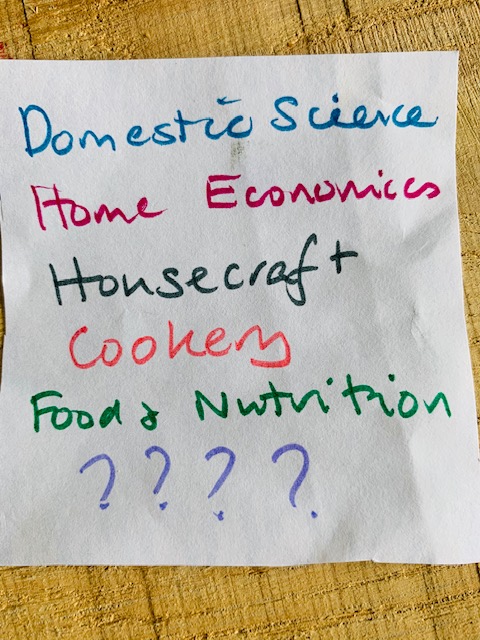
So am I the Cookery, Home Economics, Domestic Science, Housecraft, Food and Nutrition or Baking teacher?
What is the name of the subject I teach? What other school subject has five different names? If a magazine changed its title this often it would have gone bust, out of print, and defunct.
I wonder if any other teachers have been asked to rename their subject doors.
Chemistry could be Blowing things up,
Biology – Cutting things up,
Woodwork – Sawing things up,
History – Old stuff,
Art – Colouring stuff,
Physics – Boring stuff.
Why do I work in a subject with at least five different names?
And it feels as if the future of food teaching is equally dodgy and undervalued.
It doesn’t help that the cookery exams in the seventies have different titles. In the sixth form of my high school I begged to study Domestic Science. Sadly the subject was not accepted as an A level for university entrance and I had to take three other A levels as well.
My headmistress said I’d never get work if I learnt about cookery. How wrong she was.
Now in this comprehensive school, I have to teach two types of exams – O level for the cleverer ones and CSE for the rest, and they’ve got different names too.
Cookery, Domestic Science, Home Economics, Housecraft …. Bah.
But back to my door name. What is it? I am teaching them how to cook.
So let’s make a sign called Home Economics. Bah.
p.p1 {margin: 0.0px 0.0px 0.0px 0.0px; font: 11.5px ‘Century Schoolbook’; color: #141413}span.s1 {font: 8.5px Delicious}
The main tactic that I use to keep order and get things done, apart from being stern, is to tell everyone that they will take the EXAM. This is a scary choice for me, as my end of year results are judged on how many exam passes I achieve. Some of my students are not entered for any other subjects, but if I let one person off the challenge, they’ll mutter and moan and disrupt the group. So it’s one goal for all. They have to take a two or two and a half hour practical cooking exam backed up with a long written paper.
For the practical they have to cook meals, and cakes and bread and biscuits and pastry and show as many skills as they can throw into the time. I think the cookery practical is the most challenging exam that a sixteen year old can take. They are competing against themselves and must produce an edible, attractive display of food at the end of the exam time – even burnt food has to be displayed to get some marks. And they are marked throughout on technique, safety and hygiene. That exam over, they have to answer the daft and sexist questions from our silly textbooks for their written exam.
My exam training camp starts immediately the autumn term begins. There is always homework after each lesson, and anyone that forgets has a detention. They are expert at homework excuses. ‘I left it on the bus’, ‘My pen ran out’, ‘My dog ate it’, ‘Jimmy took it and didn’t give it back.’
Detention means that I have to stay late at school to supervise the miscreants, and while other teachers gossip in the staffroom, the end of my day is spent with the usual group who stay after school to complete their work. As the autumn term progresses, the detention group dwindles in size. This means two things. Firstly, the majority are learning that I mean business. Secondly, that those that don’t care bunk off and no amount of threats and remonstration will persuade them to hand in their written work. Often these students leave after the spring term and never take the dreaded exam.
But back to the subject name. What is it? Over the years the exam name changes and I tell the school office that we are to be called this and that. But in the end it is down to basics – I am teaching them how to cook!
What’s in a name?
Nigel Slater in his memoir Toast – The Story of a Boy’s Hunger –
seemed frustrated that his domestic science teacher Miss Adams
took so long to teach him cooking. He was part of the name change
when cookery became home economics, and his teacher praised
his Victoria Sandwich which ‘rose like a dream’ and had a perfect
‘crumb’.
In 1990 the subject changed its name to Food Technology.
This meant students had to learn about the industrial productionHistory notes 171
of food products and make a food product that could be sold to a
target group.
In 2020 the names began to change again. My 2021 Survey of
Food Teachers found that 62% wanted to call their subject food
and nutrition, 33% were calling it food, 2% home economics, 2%
hospitality and 1% food technology, so the confusion carries on.
2020
Eccles cakes
The quickest way is to buy Puff pastry ready made – home made rough puff pastry is a complete waste of everyone’s time.
200 g ready made puff pastry
Filling
25 g soft brown sugar
100 g currants
50 g mixed peel
½ tsp mixed spice
½ tsp ground nutmeg
Grated Lemon rind
25 g butter
Milk and sugar to glaze
Method
Preheat the oven to 220 C / Gas 7.
Roll out the pastry into an oblong and cut into 8 squares.
Mix together all the filling ingredients and place a spoonful onto each of the squares.
Brush the edges of the pastry with milk and fold the edges into the centre to seal them.
Turn over the cakes and roll out to form a circle and until the fruit just shows under the pastry. Make three slits in the top and brush with sugar and milk.
Nigel Slater in his memoir Toast – the story of a boy’s hunger – wrote about his cookery teacher Miss Adams.
‘The first lesson couldn’t have been easier. My Victoria Sandwich rose like a dream and had, according to Miss Adams, the perfect ‘crumb’ and a fine flavour.’ But then he got a job cooking in a local inn. ‘Di was teaching me more in 2 evenings a week than Miss Adams had managed in a whole year of domestic science lessons, or home economics as they had recently decided to call it.’ So he was part of the name change too.
In 1990 the subject changed its name again to Food Technology. This meant students had to learn about the industrial production of food products and make a food product that could be sold to a target group.
The government became concerned that students did not know how to cook, so Licence to Cook was started to make sure that all students learnt some basic cooking skills during their school life.
So what’s in a name?
 itaughtthemtocook.com